https://www.aeverybody.com/strategic-turning-points-from-medieval-knights-to-modern-asymmetric-warfare/
1066 was a decisive year for England. If you only remember one year, it’s likely this one. It was at the Battle of Hastings that year that the King of England was shot, the crown changed hands, and the course of British history was altered. It can be said that without Hastings, there would be no “Britain.”
Before the Battle: The Throne Was Vacant, Leading to a Struggle
The story begins in a rather bizarre way. King Edward the Confessor of England dies childless. So the question arises: who will inherit the throne?
There were several candidates:
Harold Godwinson : A native English nobleman, he was supported by Parliament (the meeting of nobles) and was quickly elected king.
Harold Hardrada : King of Norway, who claimed the throne of England.
Duke William : Lord of Normandy, who claimed that Edward had promised him the throne.
All of a sudden, the throne became a hot potato, triggering a “European brawl”.
Harold was exhausted from two battles
Harold had secured his throne, but others were dissatisfied. First, King Hardrada of Norway marched north with his army, forcing Harold to rush to meet them. At the Battle of Stamford Bridge, Harold won, forcing the Norwegians to retreat, but Harold himself was also severely injured.
But before he could rest, he heard that William of Normandy had landed in the south with his army! So Harold rushed south without stopping, ready for the second battle. As you can imagine, his troops were already exhausted.
Battle of Hastings: Knights and Shield Wall
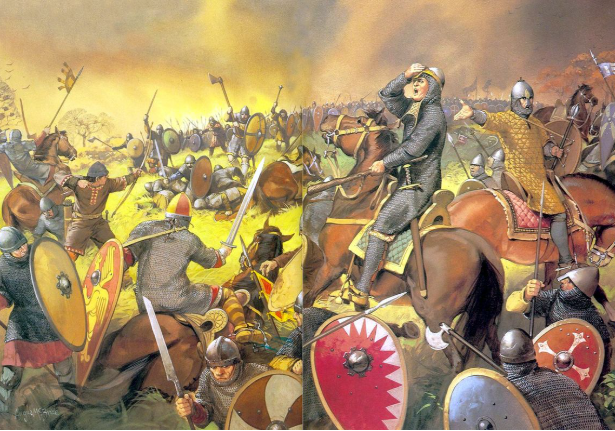
The Battle of Hastings took place in southern England. Harold’s army employed the classic “shield wall” tactic – soldiers stood shoulder to shoulder, forming a solid wall with large shields, waiting for the enemy to crash into them. This tactic had proven so effective at Stamford Bridge.
But this time, they encountered a different kind of enemy: William’s Norman knights. The Norman knights were exceptionally strong and powerful, and their impact was immense. The two sides engaged in a day-long, back-and-forth battle.
At first, the Norman knights couldn’t break through the English shield wall, and at one point, it looked like they were about to collapse. But William was cunning. He commanded his troops to “feign a retreat,” and the English soldiers, believing the enemy had truly been defeated, gave chase, disrupting their formation. Just then, the Norman knights counterattacked, completely turning the tide of the battle.
The King Falls, Fate Rewritten
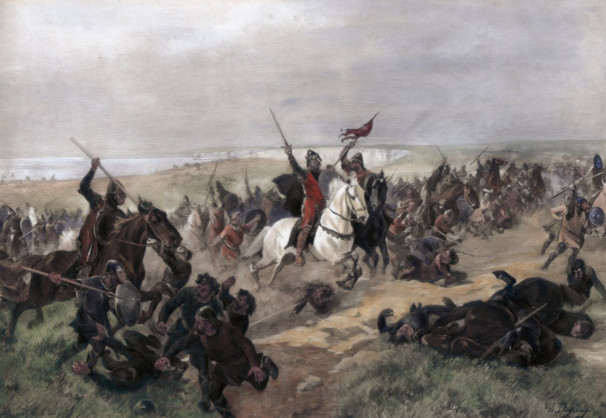
Legend has it that Harold was shot in the eye by an arrow late in the battle, killing him instantly. This scene was later engraved on the famous Bayeux Tapestry and became one of the most widely circulated battlefield images of the Middle Ages.
The death of the king threw the English army into disarray, the shield wall collapsed, and the Normans won a complete victory. William was therefore given the title of “The Conqueror” and ascended the throne of England.
Why is this battle so important?
The Battle of Hastings was not just a simple matter of “who would be king”, it completely changed the course of England.
The Norman Conquest began
With William the Great bringing Norman institutions, language, and culture. French-influenced aristocrats entered England, and English, in turn, incorporated a large number of French words. This is why today we have both “cow” and “beef” in English, one from Anglo-Saxon and the other from French.
Redistributed
The lands of England and established a stricter feudal system. The political landscape of England underwent a qualitative change.
Britain’s “mixed-race” culture,
The fusion of Anglo-Saxon traditions and Norman culture, has created a unique British culture. This dual bloodline has given Britain a position in European history that is both close and independent.
What would happen if Harold won?
Interestingly, historians often enjoy playing the “what if” game. If Harold had resisted William’s charge, England might have continued on its Anglo-Saxon path, less quickly influenced by French culture. The English language today might be completely different, and Britain’s political system might have taken a different path.
But the fact is, there are no ifs in history. The outcome of 1066 pushed England onto the path of “Normanization”, which in turn profoundly influenced the history of Britain and even the entire West.
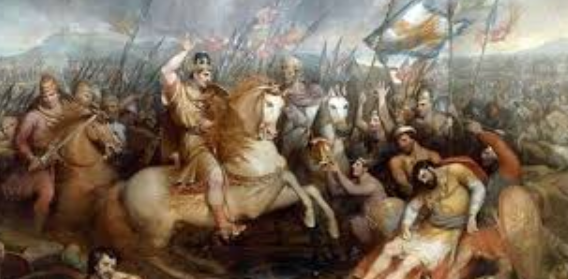
A battle, a legend
The Battle of Hastings has a unique drama. The weary king, the powerful outsider, the knights’ charge, the shield wall’s resistance, and that legendary arrow – all combined, it feels like an epic.
To this day, when the British mention 1066, they think it was the “starting point” of their history, because at that moment, England went from being a relatively isolated island nation to being part of the European power structure.
Conclusion
When the knights charged, the king fell, and history was over. The Battle of Hastings is not just the story of England, but a turning point in the history of Europe. It reminds us that sometimes a single battle can determine the fate of a nation for centuries.
So, next time someone mentions 1066, you can tell them: it is not just a number, but the beginning of a legend.
https://www.aeverybody.com/strategic-turning-points-from-medieval-knights-to-modern-asymmetric-warfare/