https://www.aeverybody.com/turning-points-of-history-decisive-battles-that-shaped-the-modern-world/
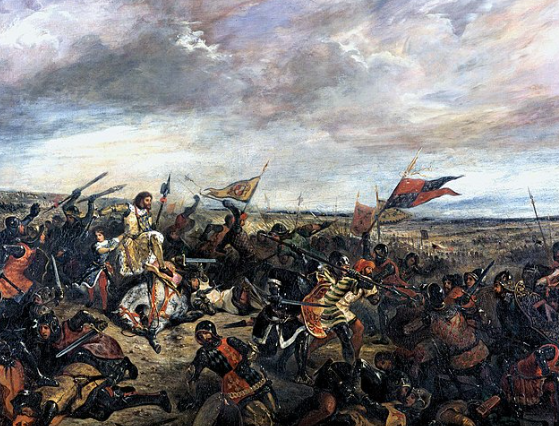
Some battles in history are more than just victories on the battlefield; they often represent much more than just victory or defeat. The Battle of Poitiers in 1356 was a case in point. The French king personally led the battle, only to be captured, his crown shed in mud and blood. This was not just a military defeat for France; it marked a major rift in the entire medieval order of Europe.
Background to the Battle of Poitiers: A Continuation of the Hundred Years’ War
The Battle of Poitiers took place in the middle of the Hundred Years’ War, a 116-year-long struggle for supremacy between England and France. Ostensibly a struggle for the English throne, it was, in reality, a comprehensive contest for territory, economy, and power.
Before Poitiers, England had already fought a brilliant battle at Crécy (1346), where its longbowmen had completely humiliated the French knights. Ten years later, the English army once again entered France, led by Edward the Black Prince, and met King John II of France at Poitiers.
This confrontation is not just a fight between soldiers, but also a contest of kingly demeanor.
Duel on the battlefield : the clash of longbows and knights
The battlefield at Poitiers was relatively small, and while the English were outnumbered, they were very agile. The longbowmen brought by the Black Prince were their secret weapon, forming a powerful front. The French favored knightly charges, with King John II leading the charge.
But the problem was that the longbowmen were too powerful, and the French knights were shot to pieces before they even got close. Their armor was not necessarily safe, and the French knights’ repeated attacks disrupted their formation, giving the British the opportunity to counterattack.
After several hours of fighting, the French grew increasingly disorganized. John II, despite his bravery, could not prevent his army from collapsing. Finally, he was surrounded and forced to surrender.
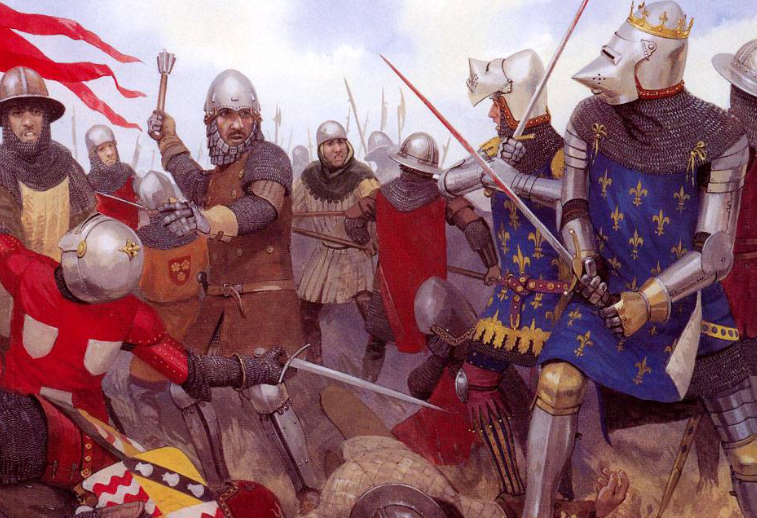
The Crown Falls: The King’s Shame
The capture of a king was an extremely rare occurrence in medieval Europe. Typically, the king served as a symbol, the spiritual pillar of the army. Yet, at Poitiers, King John II of France personally handed the sword to the Black Prince. The scene was like the moment a crown fell to the ground.
For the French, this was a profound humiliation. A king had become a hostage of an enemy nation, held in London for several years. Even more embarrassing, France had to pay a huge ransom and cede vast tracts of land to redeem the king.
For the English, this victory was like a symbolic coronation – not just a tactical success, but also a challenge and contempt for the French monarchy.
The symbolism of Poitiers
Why is this battle symbolic?
Poitiers
Medieval knights had always considered themselves masters of the battlefield. But the victory of the longbowmen showed that the era of cold weapons was changing, and the glory of the noble knights was being replaced by weapons in the hands of ordinary soldiers.
The fragility of royal power
The king’s capture made the French suddenly realize that royal power was not sacrosanct. War tests not only soldiers but also institutions. When even the highest rulers could be taken prisoner, the political foundations of the entire society were shaken.
A profound turning point in Anglo-French relations:
The battle deepened France’s internal divisions and further prolonged the Hundred Years’ War. For Britain, it was one of the closest moments to “winning all of France.” Poitiers became a symbol of the long-standing feud between France and England.
What would history be like without Poitiers?
Imagine if John II had held his ground instead of being captured. The Hundred Years’ War might have ended sooner. France might have been unified sooner, and England wouldn’t have been entangled in France for so long. In other words, Poitiers delayed the entire European power structure.
In a sense, Poitiers is like a “wake-up call”, reminding people that medieval wars are no longer about the personal heroism of knights, but a contest of technology, strategy and system.
From the battlefield to the present day: Echoes of Poitiers
When we look back at Poitiers today, we certainly don’t just see it as an ancient battle. It’s more like a symbol:
It symbolizes the collapse of the old order of the Middle Ages : the honor of the knights was shattered in the rain of arrows from the longbow.
It symbolizes the limited nature of royal power : even the most sacred monarch may fall into the mud and become a prisoner.
It symbolizes the emergence of the prototype of modern warfare : large-scale weapons and civilian soldiers began to occupy a larger proportion on the historical stage.
In other words, Poitiers was a “preview” of the transition from the Middle Ages to modern times.
Summarize
The moment the crown fell to the ground was not only a personal humiliation for King John II of France, but also a historical metaphor: even the greatest power can be shattered on the battlefield. The Battle of Poitiers engraved this irony on the pages of history.
Therefore, when we talk about Poitiers today, we should not just see it as a victory or defeat, but rather as a concentrated manifestation of the social contradictions of the Middle Ages. It allows us to see the end of one era and the beginning of another.
https://www.aeverybody.com/turning-points-of-history-decisive-battles-that-shaped-the-modern-world/