https://www.aeverybody.com/turning-points-of-history-decisive-battles-that-shaped-the-modern-world/
There are always pivotal moments in history, like forks in the road. If you had gone left, the world would be what it is today; if you had gone right, everything might have been completely different. The Battle of Salamis is one such pivotal moment. Some even say that without that naval battle in the narrow strait of 480 BC, there would have been no “Western civilization.” Does that sound a bit exaggerated? But if you think about it, there’s some truth to it.
Let’s review first:What was the Battle of Salamis?
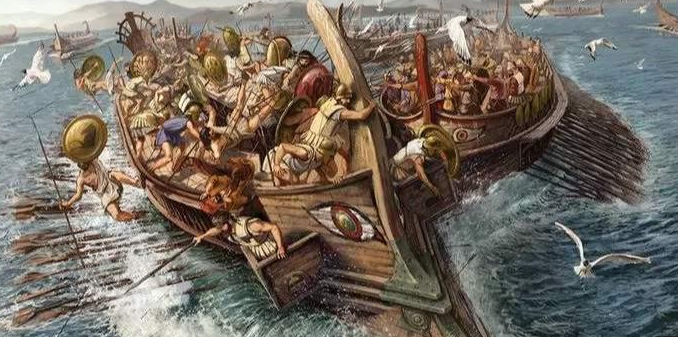
By 480 BC, the Persian Empire’s vast army had reached Greece. The year before, they had defeated King Leonidas of Sparta and his warriors at Thermopylae (the battle depicted in the film “300”). Then, marching south, they burned Athens. The Greek city-state alliance was on the verge of collapse.
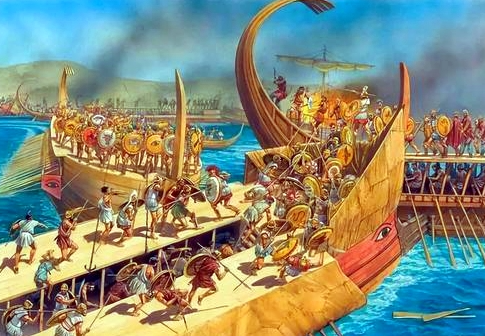
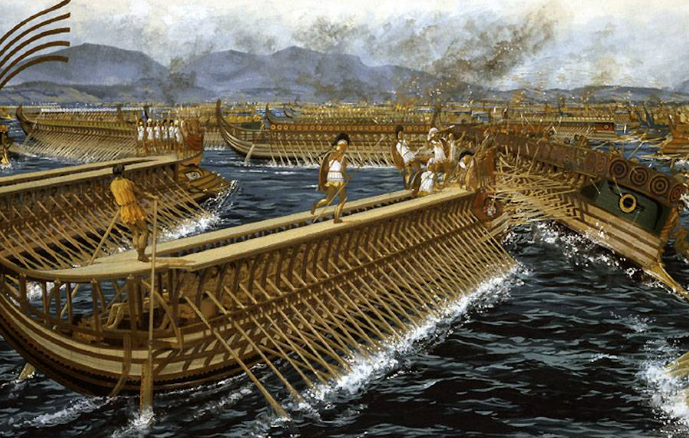
At this time, the Athenian general Themistocles came up with a brilliant plan: to concentrate the Greek fleet in the narrow strait between Salamis and the mainland to confront the Persian fleet. The result? Hundreds of nimble Greek triremes trapped the large but unwieldy Persian fleet in the narrow waterway, throwing it into disarray. Ultimately, the Persian army was routed, and Xerxes was forced to return home with his remnants.
It was this naval battle that prevented Persia from swallowing up all of Greece.
What would have happened if Salamis hadn’t happened?
Okay, now let’s get into the “what if” mode. Let’s assume the Greek fleet lost at Salamis. What would have happened?
(1) The Persian Empire completely occupied Greece
First, the Greek city-state alliance would be completely destroyed. Sparta, Athens, Corinth… these names would likely quickly fade from history. Persia would turn all of Greece into a province, just as it had done with Asia Minor.
(2) The democratic system may die prematurely
Athenian democracy served as a “test bed” for the ancient world. Had Persia successfully conquered Greece, it would likely have completely abolished these “unmanageable” democratic institutions and replaced them with its own centralized monarchy. Consequently, the profoundly influential democratic traditions that followed might not have had a chance to develop. Just imagine, without Athenian democracy, wouldn’t even modern democracy be missing a piece of the puzzle?
(3) The development of philosophy and art will be interrupted
Socrates, Plato, Aristotle, and Athenian tragedy and comedy, all of which we know today, were born after the Battle of Salamis. Had Greece been under Persian rule at the time, there might have been less room for free thought, and the “Golden Age of Philosophy” might have been stillborn. In other words, we might not have been able to read “The Republic” or “Oedipus Rex.”
(4) The changing tone of Western civilization
Many say that the victory at Salamis established the self-identity of “Western civilization”: the freedom and independence of a small nation could defeat the might of a vast empire. If Persia had won, this narrative might have been rewritten—Western civilization might no longer be centered on “freedom” but instead take a different path.
So, if Persia wins, will the world be different?
Of course, these historical hypotheses are all wildly imaginative and cannot be definitively confirmed. After all, historical development is complex, and it’s possible that after Persia conquered Greece, they didn’t completely eliminate the local intellectual traditions, but instead, a “Persian-Greek civilization” could emerge. (In fact, Alexander the Great’s later eastern expeditions did indeed create “Hellenistic civilization.”)
But one thing is certain: Salamis gave the Greek city-states time to continue to exist and develop, and this time gave birth to the foundation of Western culture as we know it today. Without this buffer, the development trajectory would at least be very different.
Why is this battle so exciting?
Many war stories endure because they carry a sense of drama, a sense of underdog triumph. The Battle of Salamis is a prime example: on one side stood the world’s most powerful empire, against a patchwork fleet of a small nation. Yet, the small nation triumphed, and triumphed spectacularly.
The fact that the battle took place in a narrow strait made it a classic example of “winning with a small advantage.” Even today, the Battle of Salamis is often used as a textbook in military academies and strategy books.
In other words: Salamis wasn’t just a battle; it was a turning point in civilization.
If Thermopylae was a “tragic sacrifice,” then Salamis was a “true turning point.” It gave the Greeks an opportunity to continue writing their own stories. These stories were later inherited by the Romans, passed down through the Middle Ages, and ultimately became the core genes of modern Western civilization.
So, when we ask, “What would the world be like without Salamis?”, the answer is probably:
The democratic system we are familiar with would likely have emerged much later;
We probably read less than half the philosophical works;
The narrative of “freedom versus power” may not exist at all.
In other words, the history book in your hand, and even the institutional environment you live in today, may look different.
Summarize
History won’t tell us the answer to “what if,” but the Battle of Salamis was indeed a watershed moment that inspires endless imagination. It allowed a small Greek city-state civilization to survive in the face of a powerful force, giving it the opportunity to influence the next two thousand years.
Therefore, those sailors who paddled and rushed desperately in the strait probably did not imagine that their victory would not only save their homes, but also, in a sense, save the world we know today.
https://www.aeverybody.com/turning-points-of-history-decisive-battles-that-shaped-the-modern-world/