https://www.aeverybody.com/naval-warfare-from-trafalgar-to-incheon/
When it comes to the most legendary naval battles in European history, the Battle of Trafalgar stands out as one of the greatest. Fought off the Atlantic coast in 1805, this battle not only firmly established the British Royal Navy as the “masters of the sea,” but also immortalized Admiral Horatio Nelson, who sealed his fame with a heroic victory marked by sacrifice.
Today, let’s explore this ultimate clash of the Age of Sail—how it unfolded, and why Nelson’s victory came from his brilliant “breaking the line” tactic rather than brute force.
1. Background: Napoleon Wants to Cross the Sea, Britain Will Not Allow It
By 1805, Napoleon had conquered nearly all of continental Europe, but Britain remained his biggest headache. Without a strong land border, Britain’s power relied entirely on its navy. The Royal Navy was well-equipped, highly trained, and firmly controlled the seas.
Napoleon knew that to invade Britain, the first step was breaking the British naval blockade to allow his troops to cross the English Channel safely. So he ordered the French and Spanish fleets to unite and launch a decisive naval battle against Britain.
But Britain was ready—sending a fleet to watch the enemy at sea, commanded by Admiral Horatio Nelson, a legendary leader who, despite having lost his right arm and right eye, remained fiercely determined.
2. Pre-Battle Comparison: More Ships vs. Superior Combat Power
In terms of numbers, the British were outnumbered. The French-Spanish combined fleet had 33 ships of the line, while Nelson commanded only 27. However, the real difference wasn’t numbers but the quality of training and tactical skill.
The French and Spanish fleets, despite their size, suffered from inconsistent leadership, poor coordination, and lax discipline. In contrast, the British fleet operated like a finely tuned war machine, with every ship and sailor knowing exactly what to do.
3. Nelson’s Masterstroke: The “Breaking the Line” Tactic
Naval battles before this were mostly about lining up ships and trading cannon fire—who had the stronger firepower usually won. But Nelson thought differently. He invented a daring tactic called “breaking the line”: he arranged his fleet into two columns that would pierce the enemy’s main formation, slicing their fleet into segments, disrupting their formation, and enabling local encirclement.
This was like slicing a loaf of bread into pieces to be devoured one by one. Though risky, if successful, the enemy would fall into chaos. Nelson’s men followed him with almost absolute loyalty, knowing this “old sea captain” always found a way to win fierce battles.
4. The Battle and the Turning Tide: Crushing 33 Enemy Ships
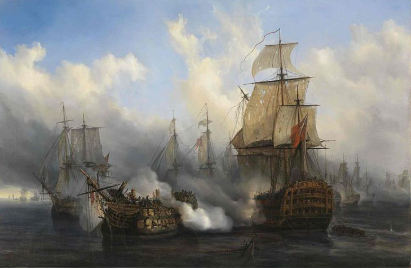
On October 21, 1805, the battle began. Nelson’s flagship, HMS Victory, led the charge, carving a bloody path through the Franco-Spanish fleet. As predicted, the enemy fleet was sliced into segments, and their command system collapsed.
The British then closed in one by one, using superior gunnery and seamless coordination to sink or capture enemy ships.
In the end, the Franco-Spanish fleet lost 18 ships captured or sunk, while the British did not lose a single vessel. This stunning victory against superior numbers became a tactical miracle.
5. Nelson’s Death: Triumph Mixed with Tragedy
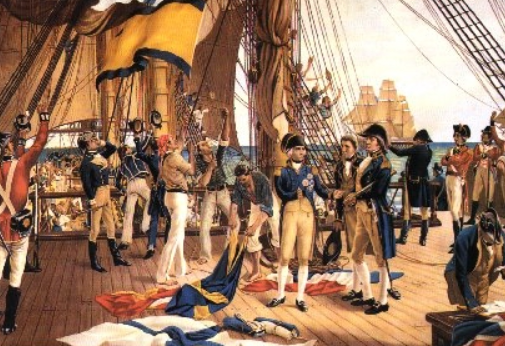
As victory was secured, Nelson was struck by a French sniper’s bullet on deck—piercing his chest. Carried below, he lay listening to the victory reports until his last breath. His final words were: “Thank God I have done my duty.”
His death cast a solemn shadow over the triumph. The nation mourned deeply, and his funeral became a state occasion. Today, his statue still stands proudly in London’s Trafalgar Square, symbolizing a man, a battle, and an empire.
6. Conclusion: A Naval Legend Immortalized
The Battle of Trafalgar not only ended Napoleon’s threat of invading Britain by sea but also secured British naval dominance for the next century, helping Britain become the true “empire on which the sun never sets.”
Nelson’s victory, won through courage and brilliant strategy, earned him a permanent place in military history, tactical manuals, and the hearts of countless people as the very definition of a hero.
He won the battle and earned eternal respect from future generations.
https://www.aeverybody.com/naval-warfare-from-trafalgar-to-incheon/